
Vetting Fragrance Suppliers on a Scent Museum Visit: A Pharmacy Scorecard
A scent museum visit is a screening tool, not a decision. Used well, it separates suppliers who can explain, teach and document scent from those who can only show a room, and it does so in a few hours. Score what you see against the range you are sourcing, write down two or three claims that need documentary support, and confirm at the factory before the supplier reaches a shortlist. The visit is cheap screening; the factory day is where the decision is actually made.
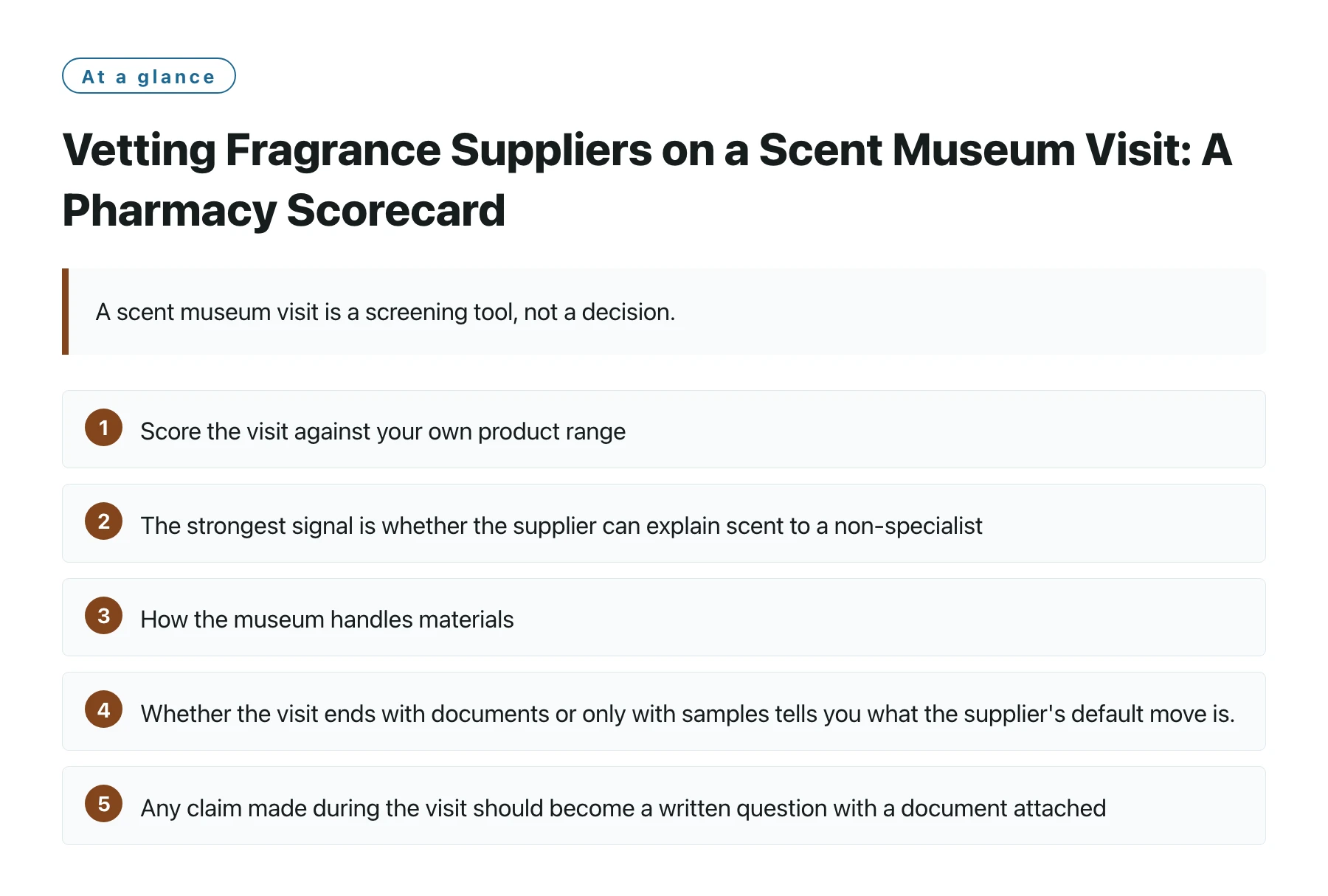
Key takeaways
- Score the visit against your own product range, not against how impressive the space is.
- The strongest signal is whether the supplier can explain scent to a non-specialist, because pharmacy retail depends on that skill.
- How the museum handles materials, storage and light is a small preview of how the factory handles them.
- Whether the visit ends with documents or only with samples tells you what the supplier's default move is.
- Any claim made during the visit should become a written question with a document attached, never an assumption.
- A museum visit cannot score production capability, so keep the factory audit as a separate, unweighted step.
Supplier visits are usually pleasant, which is exactly why they need a structure. The room is designed to make a good impression, the host is welcoming, and by the end of the afternoon it is easy to feel that the assessment has been done. It has not; what has happened is that a claim has been presented well, and the buyer now has to decide whether to test it.
That is not an argument against visiting. A well-run collection compresses a lot of information into a short time, and for a pharmacy own-label range the education side of the visit maps directly onto a real need: staff who can describe a scent consistently at the counter. The visit is a legitimate screening step as long as it is scored against the range being sourced and the scores are compared across suppliers.
The scorecard below is written for a buyer visiting two or three manufacturers in a sourcing round. It covers the signals worth recording, what each signal suggests, and the confirmation step that turns a signal into evidence.
How to run the visit so the notes are comparable
- Bring the brief, not just the scheduleWalk the collection with your own range in mind. If the range covers body mist and hand care, look for how the supplier explains those formats and their dosage constraints rather than admiring the fine fragrance display.
- Score the same six signals at every supplierUse an identical list for each visit so the notes can be compared afterwards. Six signals, scored simply, are more useful than a long narrative written from memory.
- Write claims down verbatimWhen the host says materials are traced or that staff are trained in house, write the sentence down. It becomes the question you send afterwards, and the answer is what gets filed.
- Ask what the museum is forThe answer reveals the supplier's intention: public education, client experience, internal training, or retail theatre. All are legitimate; they lead to different expectations.
- Leave with two documentsAsk for a specification example and a training outline. A supplier that can send both within a few days is organised; one that cannot has told you something useful.
- Book the factory day before you leaveSeparate the two visits in the calendar and in the scoring. The museum day screens; the factory day verifies process, records and repeatability.
The scorecard: signal, what it suggests, how to confirm
| Signal observed | What it suggests | Confirmation step |
|---|---|---|
| The host explains scent in plain language without jargon | The supplier can support counter training for a pharmacy team | Ask for the training outline and who delivers it |
| Materials are grouped by family and each label names the material | The house works in fragrance families, which maps onto a usable brief | Send a one-family brief and judge the first sample round |
| The visit includes how scent behaves over time or in different formats | The supplier thinks about application, which matters for body and hand products | Request comparative samples in two formats from the same brief |
| Storage, light and temperature are visibly controlled in the display | Housekeeping discipline that should extend to retained samples and bulk storage | Inspect bulk storage and retained-sample conditions at the factory |
| The tour ends with documents offered rather than only samples | The supplier's default move is evidence | Score how quickly the documents arrive and whether they are complete |
| Curation is credited to a named person or team | Scent knowledge is institutional rather than dependent on one individual | Ask who would handle your project if that person is unavailable |
None of these rows proves manufacturing capability. They screen for a partner who can think and communicate, which is a prerequisite rather than a conclusion.
What the visit genuinely tells you about a supplier
The clearest signal is translation. A house that can explain a material to someone who has never smelled it in isolation is a house that can help a pharmacy counter explain a product in thirty seconds. That skill is not universal, and it is hard to fake over an afternoon, because it shows up in the questions the host asks and in whether the explanation is adjusted when the visitor does not follow.
The second signal is whether scent is treated as knowledge worth preserving. Transmission of craft knowledge across generations is exactly the kind of practice that heritage frameworks, such as the UNESCO Intangible Cultural Heritage convention, were designed to recognise, and a collection that documents materials, methods and history is doing a version of that work. [1]
The third signal is intention. Some collections exist to educate the public, some to host clients, some to train staff, and some to sell. A buyer who asks the purpose and then checks whether the activities match the answer learns more than one who simply walks through.
What the visit cannot tell you is whether the supplier can repeat a batch, control fill weight, hold a specification or deliver a documented product on a date. Those are process questions, and process is checked where the process happens.
Turning a visit into a fair comparison
Score every supplier on the same six signals on the same day of the round, and keep the scores with the date. Notes written a week later flatten into impressions. Where two suppliers score similarly, the factory day is what separates them, so the shortlist should carry forward the top two or three rather than a single favourite.
The factory day does the real work
Verification at the factory is a different exercise: examine how a formula becomes a batch, what records are kept, how retained samples are stored and how a deviation is handled. Testing and inspection services such as those described by SGS exist precisely because those checks need evidence rather than assurance, and a supplier that has been through them can show the results. [2]
This is where a museum visit earns its keep or not. A supplier that was articulate and well organised on the museum day usually presents its factory records competently as well, but that is a correlation, not a guarantee. The buyer's job is to check the records regardless, and to keep the two scores apart so that a good afternoon does not become a substitute for a document.
Practical questions for the factory day are unglamorous: how a batch is released, who signs it, what happens when a raw material lot changes, how retained samples are kept, and how a complaint about a scent difference is investigated. A manufacturer that handles the whole route from development to filling, such as a factory that handles fragrance R&D and production, will have answers for each, and the answers are what the shortlist should be built on. Buyers who want a broader framework for the same exercise can work through Xuelei before the visit, so that the museum day and the factory day together produce one file.
One more point for pharmacy buyers: the counter team will meet the supplier's material before they meet the supplier. Ask at the visit whether product descriptions, training notes and claim wording can be provided in the form the retailer needs. A house that treats a fragrance museum in China as a working education asset rather than a showroom will usually answer yes without hesitation, and the quality of the answer is a fair signal in itself.
Sources
- UNESCO Intangible Cultural Heritage —— UNESCO's programme and lists for intangible cultural heritage, covering traditional knowledge and craftsmanship.
- SGS: Cosmetics, Personal Care & Household Testing —— Testing, inspection and certification services for cosmetics and personal care, including microbiological, stability and safety testing aligned with cosmetics GMP.
Frequently asked questions
Should a museum visit be part of formal supplier due diligence?
It can be, as a screening step with defined signals and a dated score. It should never replace the factory audit, because production capability, records and repeatability can only be checked where the production happens.
What is the single most useful thing to observe on a museum visit?
Whether the host can explain scent to someone who is not a perfumer. For pharmacy retail that skill transfers directly to counter conversations, which is where own-label fragrance is sold.
How many suppliers should be visited in one sourcing round?
Two or three is usually enough to make the visit useful. Visiting more tends to blur the notes, and the shortlist has to be verified at the factory anyway, which is the more time-consuming step.
What documents should I ask for at the end of the visit?
A specification example for a comparable product, a training outline, and the documentation list the supplier normally provides with an order. Asking for all three tests organisation as well as capability.
Does an impressive museum mean the supplier is more expensive?
Not necessarily, and the visit is a poor way to judge cost. Ask for the same quotation structure from every supplier in the round, and compare development fees, components, minimums and freight separately.
Hungry? The counter's got a stool for you.
Reserve a booth for brunch, grab takeout, or just swing by — we've been pouring coffee on Court Street since 1998.